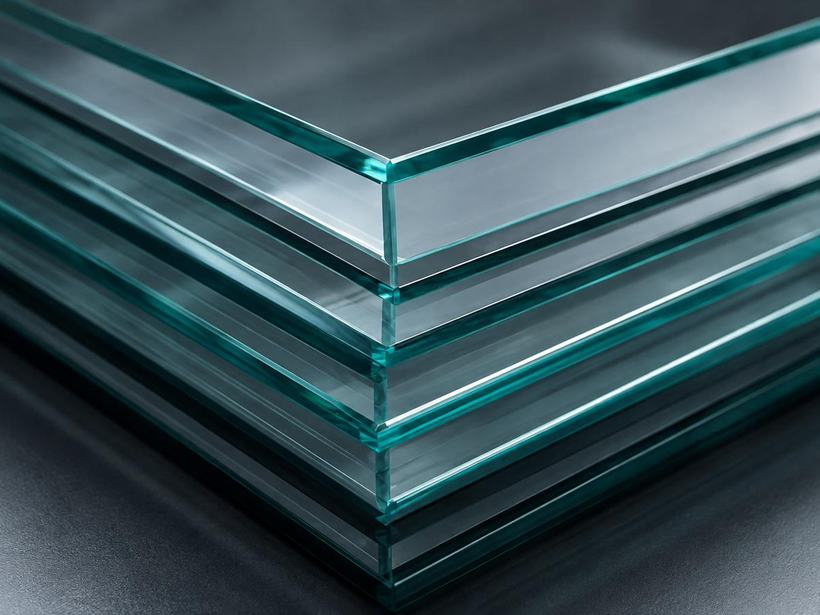
Bonded panes that hold their fragments on breakage – the standard for balustrades and overhead.
Laminated glass is two or more panes bonded to an interlayer under heat and pressure. Break it and the fragments stay stuck to that interlayer rather than falling – which is why it is the standard answer wherever glass sits overhead, at a change in level, or where anyone could fall against it.
What it does on breakage
Laminated glass is two or more panes bonded to an interlayer. When it breaks the fragments stay attached to the interlayer, so the pane usually remains in the opening and retains some residual capacity.
That is the difference that matters in a barrier. Toughened glass, if it breaks, granulates and the panel leaves the opening – which on a balustrade means the barrier is gone. It is why laminated, or laminated-toughened, is the normal choice where there is a fall risk or glazing overhead.
What the selection depends on
Interlayer type
Standard PVB is fine in a façade. In a base-clamped balustrade, where the glass itself carries the barrier load, a stiffer structural interlayer is normally specified because PVB softens as temperature rises and allows more deflection under sustained load. Which one is required comes from the project engineer.
Thickness and build-up
Set by the barrier loading, the span and the fixing method. We work to the build-up the consultant or engineer specifies rather than proposing one.
Edge condition
Exposed edges on a frameless balustrade need a polished finish. On low-iron glass the edge reads clean; on standard float it reads green.
Fixing and edge cover
Glass must never bear directly on metal. Setting blocks and the correct edge cover are what prevent point loading – the usual cause of a pane failing months after handover with no apparent impact.
What we need to quote
Pane sizes with tolerances
Required build-up and interlayer, or the engineer's specification
Edge finish – arrissed, ground or polished
Hole positions, diameters and edge distances
Application: balustrade, overhead, façade or partition
Whether dimensions are surveyed or still nominal
Processing happens before toughening
If the build-up includes toughened glass (also called tempered glass), every hole, notch, cut-out and edge finish must be on the schedule before the glass goes through the furnace. Toughened glass cannot be cut or drilled afterwards – the attempt shatters it.
A late change to a fixing position is therefore a new pane and a new lead time, not an adjustment. We check schedules for this before processing.
Specification noteInterlayer type and pane build-up are selected against the loading and safety requirements set for the project. We work to the consultant's specification.
Related reading: specifying laminated glass for balustrades.
Related
More from Glass Products
01
Clear Float Glass
The standard flat glass most other architectural glass is processed from.