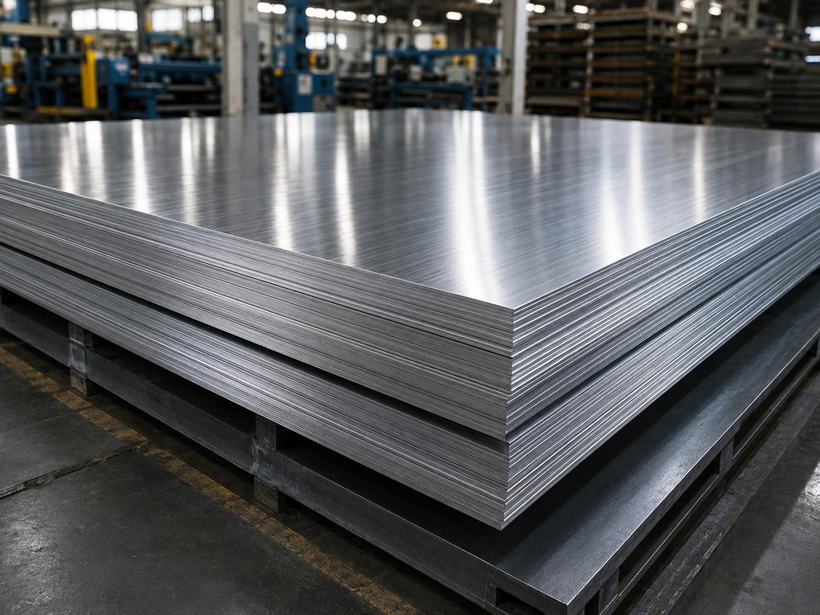
Sheet and plate in a range of finishes, for cladding, trims, signage, workshop fabrication and load-bearing components.
Sheet and plate in mill, polished, brushed, embossed and coated finishes
Aluminium Sheets & Plates
Sheet and plate in a range of finishes, for cladding, trims, signage, workshop fabrication and load-bearing components.
Most enquiries here come down to finish and gauge. Mill finish where the surface will be coated or hidden; brushed or polished where it will be seen; embossed where it will be walked on; plate where it will be machined or loaded. Give us the application and quantity and we will confirm what to order and cut it to size.
Finish decides how a sheet looks; alloy and temper decide how it behaves. The notes below cover the designations that appear on most enquiries for aluminium sheet and plate in the UAE and export markets.
1050 / 1100 (1xxx)
Commercially pure. Highly formable, good corrosion resistance, lower strength. Common for general sheet, trims and formed panels.
3003 / 3105 (3xxx)
Manganese alloyed. Stronger than 1xxx while staying formable and weldable. Widely used for general sheet, cladding and fabrication.
5005 / 5052 / 5754 / 5083 (5xxx)
Magnesium alloyed. Higher strength and good resistance in marine and coastal conditions. 5005 is the usual choice for anodising; 5052 and 5754 for tread plate and exposed work; 5083 for marine and heavier plate.
6061 / 6063 (6xxx)
Heat-treatable. Used where the part is structural or machined. 6063 is the usual architectural extrusion alloy.
Tempers in plain terms
Temper
What it means
O
Annealed – the softest condition. Easiest to form, lowest strength.
H14 / H24
Half-hard. The most commonly supplied condition for general sheet, balancing strength against formability.
H112
Supplied in the as-fabricated condition, commonly seen on plate.
T6
Solution heat-treated and artificially aged. Used on 6xxx alloys where strength matters.
Sizes and standards
1000 × 2000 mm, 1250 × 2500 mm and 1500 × 3000 mm are the most commonly produced sheet sizes; other sizes depend on alloy, gauge and mill, and material can be cut to size. Sheet and plate are commonly produced to EN 485 or ASTM B209, depending on product and producer. Final alloy, temper, thickness, size and finish are confirmed against the project requirement at quotation.
Common questions
What is the difference between aluminium sheet and plate?
Material below approximately 6 mm is commonly called sheet, and material around 6 mm and above is called plate, although the terminology varies by market and supplier.
Which aluminium alloy should I specify?
It depends on what the part does. 1xxx alloys form easily and resist corrosion well but are not strong. 3xxx is the usual general-purpose choice. 5xxx is specified where strength, anodising or coastal exposure matters. 6xxx is used where the part is structural or machined.
What does H14 mean?
H14 is a temper designation for a half-hard condition – roughly midway between annealed and fully hard. It is the most commonly supplied condition for general-purpose sheet because it balances strength and formability.
What aluminium sheet sizes are commonly available?
1000 × 2000 mm, 1250 × 2500 mm and 1500 × 3000 mm are among the most commonly produced. Other sizes depend on alloy, gauge and manufacturer, and material can be cut to size.
Do you export aluminium sheet and plate?
Yes. Sheet and plate are quoted for export from Dubai to the GCC, North Africa, the United Kingdom and selected European markets. See export supply for what to include in the enquiry.
Other ranges
More from the Trading & Supply Division
Aluminium Products
Sliding doors, curtain wall, thermal and standard frames, handrails, kitchen profiles and coated sections.