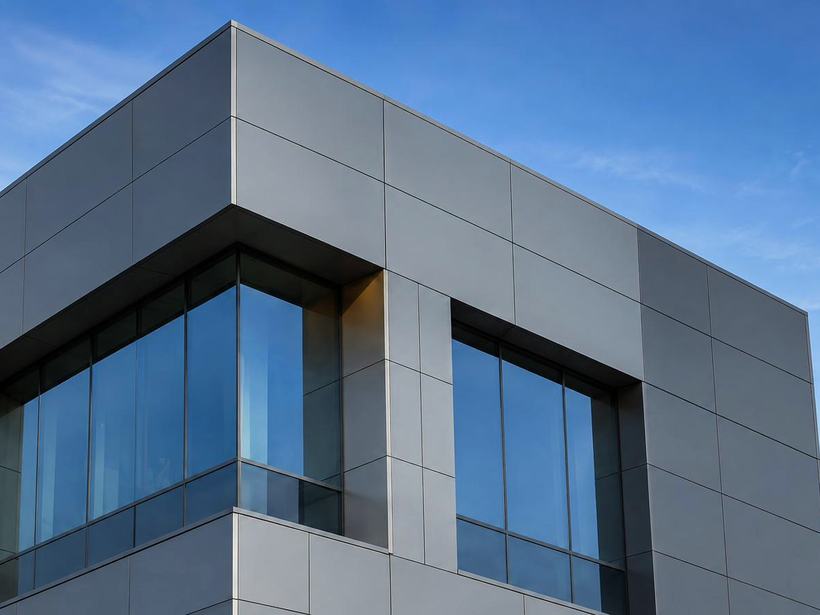
Aluminium Composite Panel gives you a large, genuinely flat façade panel at a fraction of the weight of solid aluminium – which is why so much commercial cladding in the region is ACP.
Composite panel for façades, interiors, signage and ceilings
ACP Solutions
Aluminium Composite Panel gives you a large, genuinely flat façade panel at a fraction of the weight of solid aluminium – which is why so much commercial cladding in the region is ACP.
The decision that matters on ACP is the core, because it governs fire performance and therefore approval. We supply against the specification your fire strategy sets and provide the manufacturer's documentation. Panels can be delivered for your own installer, or routed, folded and fitted as part of the supply.
ACP is specified by its core. The aluminium skins are the same; the core is what determines fire performance, weight, cost and how the panel fabricates.
PE core
A polyethylene core. The lightest and least expensive option, and the easiest to fabricate. Its use on façades is restricted in the UAE by building height and occupancy, so on most external work above low rise it will not be the permitted option. Commonly used for signage and interior applications.
FR core
A fire-retardant core – mineral-filled polyethylene. The usual middle option where the fire strategy calls for better performance than PE but does not require a non-combustible core.
A2 core
A limited-combustibility core with a much higher mineral content. Specified where the fire strategy or the building's height and use require it. Heavier and more expensive, and it behaves differently during fabrication – the routing and folding allowance is not the same as PE.
Which core is permitted is set by the project's fire strategy and the applicable UAE requirements for that building – it is a consultant decision, not a supplier one. In the UAE, fire performance evidence for façade materials is normally expected in the form of test documentation for the specific product in the specific system. Tell us the core required and we will supply against it and pass on the manufacturer's documentation.
In this range
Explore the acp solutions range
01
Exterior Cladding ACP
Two aluminium skins on a core – large, genuinely flat façade panels at low weight.
After the core, three things decide most ACP specifications: the coating, the panel size and thickness, and the colour. These apply across exterior cladding, interior walls, signage and ceilings.
Coating: PE or PVDF
PE (polyester) coatings are normally specified for interior panels, signage and ceilings. PVDF (fluoropolymer) coatings are normally specified where the panel is exposed to weather and UV, because they hold colour and gloss far better over time. In a Gulf climate that difference is not marginal on a south or west elevation.
Sizes and thickness
1220 × 2440 mm is the most widely produced sheet size; 1250 × 3200 mm and 1500 × 3050 mm are also common. For façades, panels are also commonly produced in 1250 mm and 1500 mm widths with lengths cut to the panel design. 4 mm is typical for exterior cladding, 3 mm for interiors, ceilings and signage. Other dimensions are produced depending on manufacturer and project.
Finishes
Finish families commonly available include solid colours, metallics and high-gloss; mirror finishes in silver, gold and tinted tones; brushed metallics in silver, gold, rose gold and black; pearlescent; and wood-grain and marble or stone effects. PVDF-coated solid and metallic colours are the usual choice for full exterior elevations; decorative effects are used mainly indoors and on feature areas.
Colour
Minimum order quantities are often set per colour rather than per sheet. Standard colours are quicker and available in smaller quantities; a specific brand colour may need to be coil-coated to order. Send the colour reference with the enquiry.
Common questions
What is the difference between PE and PVDF coated ACP?
PE (polyester) is normally specified for interior panels, signage and ceilings. PVDF (fluoropolymer) is specified where the panel is exposed to weather and UV, because it holds colour and gloss far longer.
What is the difference between PE, FR and A2 ACP panels?
They describe the core. A PE core is polyethylene. An FR core is mineral-filled with reduced polyethylene. An A2 core is highly mineral-filled. A2 is a reaction-to-fire classification achieved by a specific tested product, not a property of a core type in the abstract; the classification you need comes from the project's fire strategy.
What ACP sheet sizes are commonly available?
1220 × 2440 mm is the most widely produced size. 1250 × 3200 mm and 1500 × 3050 mm are also common. Other dimensions are produced depending on manufacturer and project requirement.
Can ACP be sourced in a specific colour?
Usually, though minimum order quantities are often set per colour. Standard colours are quicker and available in smaller quantities; a specific brand colour may need to be coil-coated to order.
Do you supply mirror, brushed, wood-grain or marble ACP?
Yes. Mirror (silver, gold and tinted), brushed (silver, gold, rose gold and black), wood-grain, marble and pearlescent finishes are commonly available, alongside solid and metallic colours. Ranges vary by producer, so finishes are confirmed with samples at enquiry.
Do you export ACP from Dubai?
Yes. Aluminium composite panel is quoted for export to the GCC, North Africa, the United Kingdom and selected European markets. Tell us the destination and the fire classification your market requires. See export supply.
What information do you need to quote ACP?
Application, panel thickness, sheet size or total area, core requirement, coating, colour reference, quantity, delivery location, and any documentation the project requires. If the fire strategy sets a classification, include it.
Other ranges
More from the Trading & Supply Division
Aluminium Products
Sliding doors, curtain wall, thermal and standard frames, handrails, kitchen profiles and coated sections.