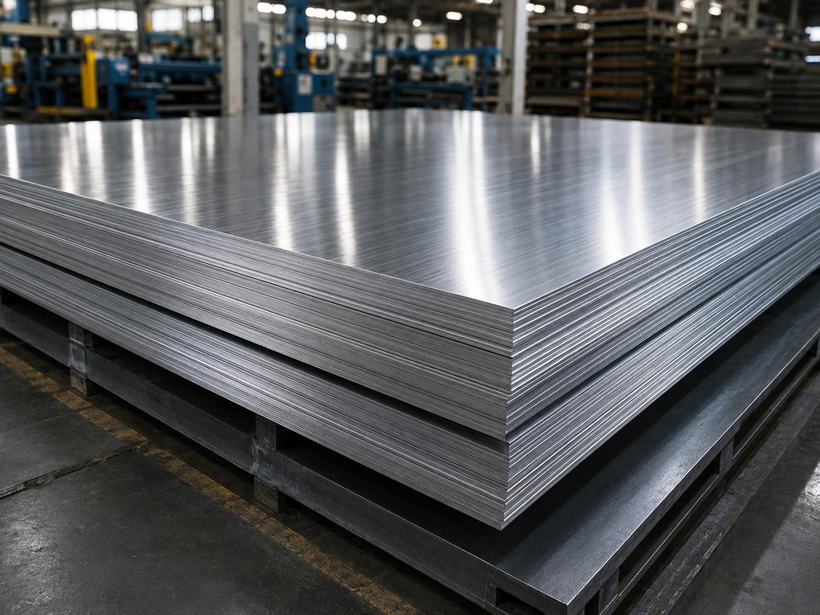
Rolled pattern that adds grip underfoot and stiffness, for treads and walkways.
Rolling a pattern into the sheet does three useful things at once: it adds slip resistance underfoot, it stiffens the panel against the flatness a plain sheet struggles to hold, and it disguises the scuffs that a working surface picks up.
Specifications commonly available
Specification
Commonly available
Material
Aluminium
Thickness
Sheet commonly from approximately 0.5 mm to 6 mm
Common sizes
1000 × 2000 mm · 1250 × 2500 mm · 1500 × 3000 mm, among others
Alloy families
1xxx · 3xxx · 5xxx, and selected 6xxx for structural work
Common tempers
O · H14 · H24, and others depending on alloy and product
Commonly produced to EN 485 or ASTM B209, depending on product and supplier
Finish
Embossed or stucco pattern; five-bar tread pattern where specified
The combinations above describe what the market commonly produces. Final alloy, temper, thickness, size and finish are confirmed against the project requirement at quotation.
Alloys for stucco and tread plate
Stucco embossed sheet is most commonly produced in 1050, 1100 and 3003, for cladding, linings, insulation jacketing and cold-room panels. Tread plate – the five-bar or diamond pattern used on floors and steps – is usually 3003 for interior and light-duty use, and 5052 or 5754 where the floor is outdoors, near the sea or carries heavier loads.
Two very different products share the word “embossed”. Stucco is a shallow, irregular texture rolled into thin sheet; it hides dents and glare and is used for linings, wall cladding, pipework insulation jacketing and refrigerated panels. Tread plate carries a raised pattern on thicker material and is used for floors, steps, ramps, vehicle beds and toe boards. An enquiry that only says “embossed” can be priced as either.
Thickness for floors and steps
Tread plate thickness is normally quoted for the base sheet, excluding the height of the raised pattern, but practice varies between producers – confirm which figure a quotation refers to. The span between supports decides the thickness more than anything else, so give us the support spacing, the load and how the floor is used: pedestrian, trolley or vehicle.
The pattern adds stiffness as well as grip, so an embossed sheet behaves differently from a plain one of the same gauge.
What we need to quote
Alloy and temper, or a description of the application
Thickness, with tolerance if it is critical
Sheet size or cut sizes, and quantity
Required finish
Whether forming, machining or coating follows
Delivery location, or port and destination for export
Any certificate the project requires
Pattern, alloy and gauge are sourced against the application rather than from one range.
These products are supplied for UAE projects and quoted for export enquiries, subject to specification, quantity and destination.
Specification notePattern type, sheet thickness and size are confirmed against the enquiry and the intended loading.
Common questions
What is the difference between stucco embossed sheet and chequer plate?
Stucco is a shallow, random texture on thin sheet, used for cladding, linings and insulation jacketing. Chequer or tread plate has a raised five-bar or diamond pattern on thicker material, used for floors, steps and ramps.
Which alloy is used for aluminium tread plate?
3003 is common for interior and light-duty floors. 5052 or 5754 is specified where the plate is outdoors, in a marine or coastal setting, or carries heavier loads.
Is aluminium tread plate slip resistant?
The raised pattern gives much better grip than plain sheet, but slip resistance also depends on wear, contamination and footwear. If the project specifies a slip-resistance rating, send the rating and test method so it can be checked against the manufacturer's data.
What do you need to quote embossed sheet?
Whether you need stucco or tread pattern, the alloy if specified, thickness, sheet size or cutting list, quantity, support spacing and load for floors, and the delivery location or export destination.
Related
More from Aluminium Sheets & Plates
01
Mill Finish Sheets
Untreated as-rolled sheet – the economical choice where the surface will be coated or concealed.