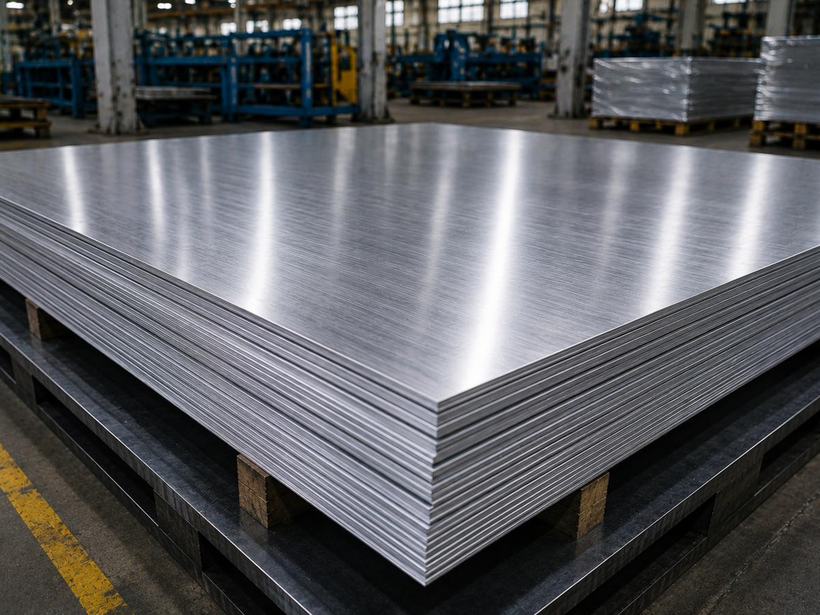
Heavier gauges for machining, brackets, base plates and load-bearing components.
Where sheet stops, plate begins. The heavier gauges are specified when the component has to carry load, be machined, or hold tolerance under working conditions rather than simply cover a surface.
Plate is specified differently from sheet
Plate is the heavier gauge material used where the component carries load or is machined – brackets, base plates, structural fixings, machined parts. Sheet is for cladding, trims and formed panels.
The practical difference at enquiry is that plate is usually bought to an alloy and temper for a mechanical reason, where sheet is often bought to a finish for an appearance reason.
What the selection depends on
Alloy and temper
These determine strength, corrosion behaviour and how the material responds to machining and forming. If your drawing specifies them, send the specification. If it does not, tell us what the part does and we will confirm what we can supply against it.
Thickness and tolerance
Plate tolerance matters where the part is machined or bolted through. Tell us if the thickness is critical rather than nominal.
Cut size and format
Cutting to size before delivery usually costs less than buying full plates and cutting on site, and it removes the offcut.
Surface condition
Mill finish is normal for plate. Where the part is visible or will be coated, say so – it changes handling and protection.
What we need to quote
Alloy and temper, or a description of the application
Thickness, with tolerance if it is critical
Cut sizes and quantities, or full plates
Whether machining or forming follows
Delivery location, or port and destination for export
What affects lead time
Stock items in common thicknesses move quickly. Specific alloys, tempers or thicknesses outside normal stock are a mill order, and that is a different timescale entirely.
Tell us your required date with the enquiry. We would rather propose an available alternative that meets the requirement than quote something we cannot deliver on your programme.
Specifications commonly available
Specification
Commonly available
Material
Aluminium
Thickness
Plate commonly from approximately 6 mm to 25 mm, with heavier gauges to order
Common sizes
1250 × 2500 mm · 1500 × 3000 mm, among others; cut to size available
Alloy families
Commonly 5xxx and 6xxx for plate applications; 1xxx and 3xxx where strength is less critical
Common tempers
O · H112 · T6, depending on alloy
Finish
Mill finish is normal for plate
Standards
Commonly produced to EN 485 or ASTM B209, depending on product and supplier
Final alloy, temper and thickness are confirmed against the component's requirement at quotation.
These products are supplied for UAE projects and quoted for export enquiries, subject to specification, quantity and destination.
Specification noteGrade and temper selection depends on the mechanical and corrosion requirements of the application. Please provide these details with your enquiry.
Common questions
What is the difference between aluminium sheet and plate?
Material below approximately 6 mm is commonly referred to as sheet, and material around 6 mm and above as plate, although the terminology varies by market and supplier.
Which alloy should I specify?
It depends on what the part does. 1xxx alloys form easily and resist corrosion well but are not strong. 3xxx is the usual general-purpose choice. 5xxx is specified where strength or coastal exposure matters. 6xxx is used where the part is structural or machined. Final alloy and temper should be selected against the fabrication, strength and corrosion requirements of the project.
What does H14 mean?
It is a temper designation. H14 is a half-hard condition – roughly midway between annealed and fully hard – and it is the most commonly supplied condition for general-purpose sheet, because it holds a useful balance between strength and formability.
Can material be supplied with a mill certificate?
Mill certificates and technical datasheets can normally be requested for the material supplied. Tell us at enquiry stage if your project, consultant or import process requires specific documentation, so availability is confirmed before the order rather than after.
Related
More from Aluminium Sheets & Plates
01
Pre-Coated Sheets
Coil-coated colour sheet, removing a painting stage from the programme.