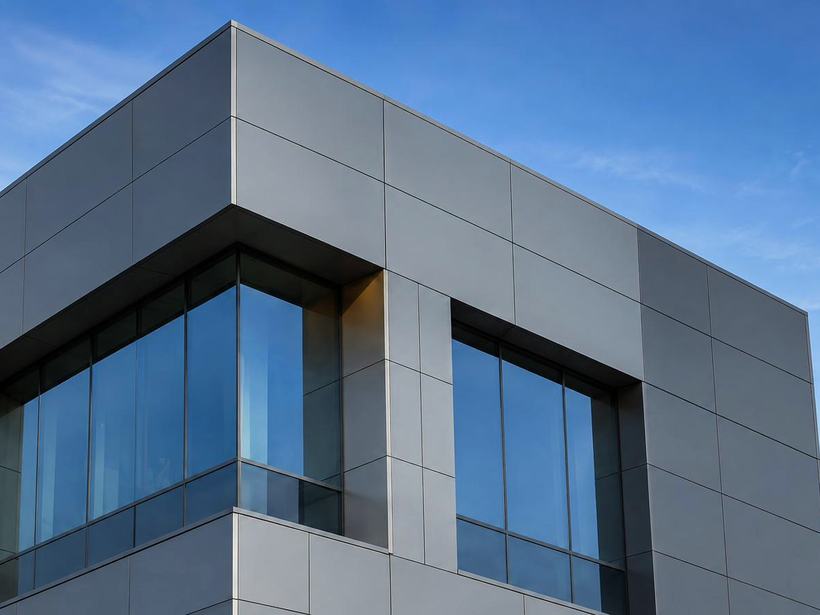
Rigid, printable panel that stays flat across a large sign face.
Signage lives or dies on flatness. A panel that oil-cans or bows turns crisp branding into something that looks cheap from across a car park. ACP's rigidity at low weight is precisely why the signage trade adopted it.
Core and coating for signs
Signage panels are almost always PE core: light, inexpensive and easy to cut, rout and fold into trays, fascia boxes and letters. A large fascia fixed to a building elevation can be treated as part of the façade by the fire strategy, in which case an FR or A2 panel may be required. For the coating, PE is fine indoors and for short-life promotional signs; long-term exterior signs should be PVDF so the brand colour does not fade.
3 mm typical for signage; 2 mm produced for lightweight work
Aluminium skin
Commonly 0.06–0.21 mm for signage grades
Common sheet sizes
1220 × 2440 mm · 1250 × 3200 mm
Core
PE is standard for signage
Coating
PE for interior signage; PVDF where the sign is outdoors and colour must hold
Finish
Wide colour range, plus brushed and mirror effects – subject to manufacturer
Fabrication
Cuts, routes, folds and takes direct print or vinyl
Signage grades use a thinner aluminium skin than cladding grades. That keeps the sheet light and easy to cut and fold, which is what a sign maker wants. It also means a signage panel is not a substitute for a cladding panel on a façade, even in the same colour.
Colour is usually the constraint, not the panel
Minimum order quantities on ACP are often set per colour rather than per sheet. A run in a stock colour behaves very differently from a brand colour that has to be coil-coated to order. If the colour is fixed by a brand guideline, tell us early – it affects both lead time and the minimum we can quote.
Signage work often needs a particular colour in a modest quantity. Sourcing across several producers is usually what makes that quantity possible.
These products are supplied for UAE projects and quoted for export enquiries, subject to specification, quantity and destination.
Specification notePanel size, thickness, finish and fixing method are confirmed against the sign design and its mounting location.
Fire performance belongs to a specific panel from a specific manufacturer, tested as a complete system. The classification required is set by the project's fire strategy, and we supply against that specification with the manufacturer's documentation. A core description is not a classification.
Finishes for signs and shopfronts
Beyond solid colours, signage work regularly uses high-gloss panels for fascias, mirror silver and gold for lettering and trims, and brushed metallics for premium shopfronts and building signage. Mirror and brushed effects scratch more easily during fabrication, so keep the protective film on until the sign is installed.
Common questions
What thickness of ACP is best for signs?
3 mm is standard for most fascias and sign trays. 2 mm suits lightweight indoor and temporary signs. For large outdoor sign faces, a heavier aluminium skin keeps the face flatter.
Can ACP be printed on directly?
Yes. ACP takes UV flatbed printing and applied vinyl. Many producers offer a white grade intended for direct print; keep the protective film on until the panel goes into the printer.
Is signage ACP the same as cladding ACP?
No. Signage grades use a thinner aluminium skin, which keeps them light and easy to fabricate, but they are not a substitute for a cladding panel on a façade, even in the same colour.
Should outdoor signs use PE or PVDF coated ACP?
PVDF for any sign expected to last outdoors, because it holds colour and gloss under UV far longer. PE is acceptable indoors and for short-term promotional signage.
What information do you need to quote signage ACP?
Panel thickness, colour or brand colour reference, quantity in sheets, sheet size, whether the panels will be printed, indoor or outdoor use, and the delivery location.
Related
More from ACP Solutions
01
Exterior Cladding ACP
Two aluminium skins on a core – large, genuinely flat façade panels at low weight.