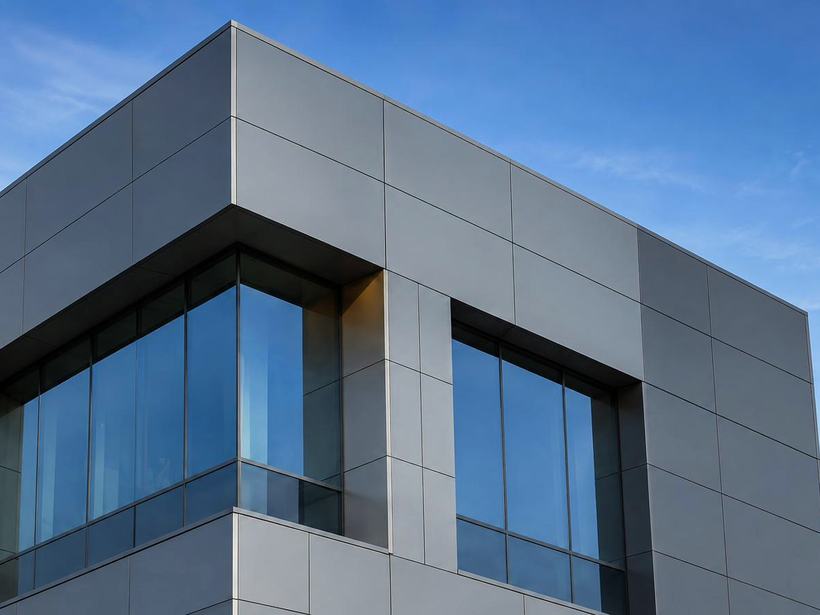
Routed and folded cassettes that hold a crisp shadow gap across lobby and retail walls.
Indoors, ACP earns its place on flatness and joint control. Large panels can be routed and folded into shadow-gap cassettes that hold a crisp line across a wall – difficult to achieve in plasterboard and considerably heavier in solid metal.
Core and coating for interior walls
Most interior wall cladding uses a PE-core panel: it is the lightest, the least expensive, and the easiest to rout and fold into cassettes. Where the fire strategy sets a reaction-to-fire class for wall linings, an FR or A2 product is specified instead – and because mineral cores fold differently, the cassette details may need adjusting. A PE (polyester) coating is normal indoors; PVDF is worth specifying where walls are cleaned hard or catch strong sunlight through glazing.
Aluminium composite panel for interior wall cladding
Panel thickness
3 mm typical for interior; 4 mm where a flatter face is wanted
Aluminium skin
Commonly 0.21–0.30 mm for interior applications
Common sheet sizes
1220 × 2440 mm · 1250 × 3200 mm
Core options
PE · fire-retardant mineral-filled · A2 mineral, where the fire strategy requires it
Coating
PE is normal for interior; PVDF where cleaning or UV through glazing is a factor
Finish
Solid, metallic, brushed, wood and stone effect – subject to manufacturer
Fabrication
Routed and returned, or cassette
Interior panels are usually lighter than exterior ones because they are not carrying wind load or weather. That makes handling easier and the panels cheaper – but it also means a thin skin will show every irregularity in the substrate behind it. Where the wall is a feature, specify up.
Interior does not always mean no fire requirement
An atrium, a lobby, a protected corridor or an escape route can carry a reaction-to-fire requirement even though the panel is indoors. Check the fire strategy before assuming a standard PE-core panel is acceptable.
Because we buy from several producers, an interior panel can be matched to the finish an architect has specified rather than to whatever one supplier happens to hold.
These products are supplied for UAE projects and quoted for export enquiries, subject to specification, quantity and destination.
Specification noteInterior applications remain subject to the fire performance requirements set for the building. Panel core and finish are confirmed against the approved specification.
Fire performance belongs to a specific panel from a specific manufacturer, tested as a complete system. The classification required is set by the project's fire strategy, and we supply against that specification with the manufacturer's documentation. A core description is not a classification.
Decorative finishes for feature walls
Interior work is where ACP's decorative finishes earn their place: solid colours, metallics and high-gloss; mirror finishes in silver, gold and tinted tones; brushed metallics in silver, gold, rose gold and black; pearlescent; and wood-grain and marble or stone effects. Marble and wood effects give the look of stone or timber cladding at a fraction of the weight and without the joints, and mirror or brushed panels make strong reception and lift-lobby features.
Decorative ranges vary by producer and change with the market, so finishes are confirmed with physical samples at enquiry. Order a feature wall from one production batch – printed and brushed finishes in particular vary between runs.
Common questions
What thickness of ACP is used for interior wall cladding?
3 mm is the usual choice indoors. 4 mm gives a flatter face on large panels and feature walls, and is worth the extra cost where the wall is lit from the side.
How is interior ACP cladding fixed?
Usually as routed-and-folded cassettes hung on a concealed subframe, which gives a crisp shadow gap and lets individual panels be removed later. Simpler work can be fixed flat to a prepared substrate. The fixing method sets the panel sizes, so agree it before panels are cut.
Can interior ACP panels match wood, stone or metal finishes?
Yes. Wood-grain, stone-effect, metallic, brushed and solid colours are all produced, subject to manufacturer and minimum quantity. Send the finish reference or a sample with the enquiry.
Do interior ACP panels need a fire-rated core?
Sometimes. Escape routes, atria, protected lobbies and some public spaces can carry a reaction-to-fire requirement for wall linings. Check the fire strategy before assuming a PE-core panel is acceptable.
What information do you need to quote interior ACP?
Wall elevations or areas, panel thickness, finish and colour reference, core requirement, fixing method, quantity, and whether you need supply only or supply and installation.
Related
More from ACP Solutions
01
Exterior Cladding ACP
Two aluminium skins on a core – large, genuinely flat façade panels at low weight.